
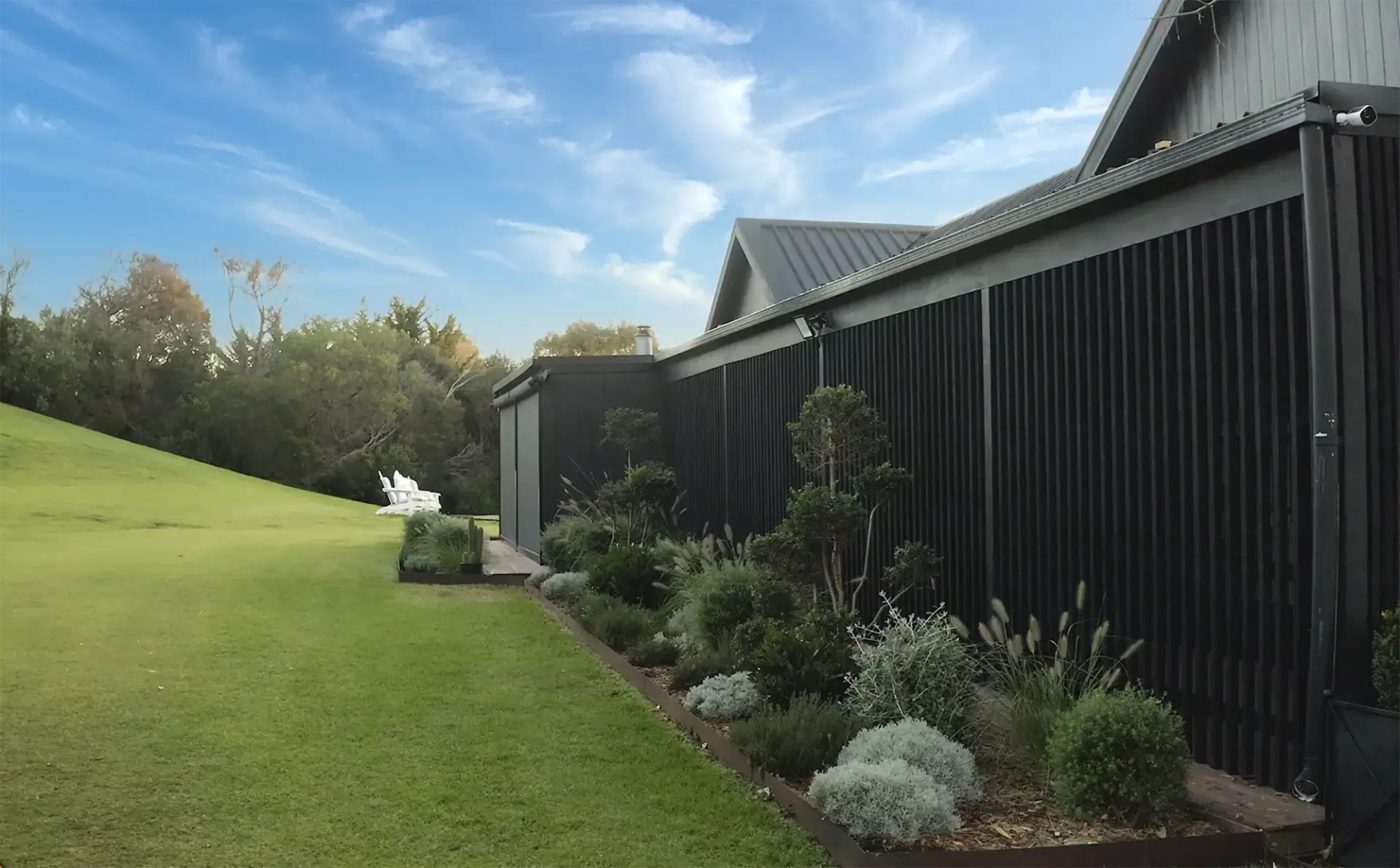
Landscaping a New Home in Melbourne: Where to Start When the Builders Leave
The soil around a newly built house is usually the worst soil in the street. Topsoil gets scraped away before the slab goes down, trucks and trades pack the subsoil hard for months, and brick rubble and concrete slurry end up buried under a thin skin of fill. That is why landscaping a new home goes wrong when it starts with a trolley of plants. Start with the ground, work in the right order, and the same budget buys a garden that settles in during its first year.
What is the right order for landscaping a new home?
To landscape a new home, start with the soil, not the plants. Clear builder’s rubble, loosen the compacted ground and dig in compost. Then build paths, paving and retaining walls, plant trees and screening hedges, fill in with shrubs and ground covers, mulch every bed, and lay the lawn last.
Here is that sequence in more detail.
- Check the rules. Most new estates have developer guidelines for the front garden, and they sit in your contract of sale. A canopy tree is a common requirement, and artificial turf out the front is often ruled out.
- Find your services. Lodge a free enquiry with Before You Dig Australia before a spade or a post-hole digger goes in.
- Fix the soil. This is the step that decides everything after it.
- Build the hard surfaces. Paths, paving, edging, retaining walls and any irrigation pipe go in before plants, so nothing gets trampled.
- Plant the big things first. Trees and screening hedges take the longest to do their job.
- Fill in. Shrubs, strappy plants and ground covers.
- Mulch, then lawn. Turf goes down last because it hates wheelbarrow traffic.
What do builders leave behind in your soil?
Dig a test hole 30cm deep in three or four spots around the block. You are looking for three things: rubble, a hard layer your spade bounces off, and how fast the hole drains when you fill it with water.
If water is still sitting there the next morning, you have a drainage problem to solve before you plant anything.
Pull out the rubble you find. Then loosen the ground to a spade’s depth with a garden fork, spread a 5cm layer of compost over the top and work it through. We use and recommend Humus Plus Organic Compost for this, and you will find it with our compost and soil range.
Do this once, properly, across every bed. It is far harder to fix soil around plants that are already in.
Is your new block clay or sand?
This is where one generic “Melbourne” answer falls over. Our three stores sit on very different ground, and the fix for one is wrong for the other.
| Heavy clay | Sandy soil | |
|---|---|---|
| Where you find it | Much of Melbourne’s south-east, including around Heatherton | Common on the Mornington Peninsula and the Bellarine |
| How it behaves | Sticky and waterlogged in winter, sets like concrete in summer | Drains in minutes, dries out fast, can repel water |
| What to add | Gypsum, then compost | Compost, and plenty of it |
| Watch out for | Digging when it is wet, which smears and seals it | Fertiliser and water washing straight through |
On clay, Gardening Australia suggests gypsum at half to one kilogram per square metre, dug in. It does not work on every clay, so test first. Drop a dry crumb of your clay into a glass of rainwater and leave it for a day. If a cloudy halo spreads from the crumb, gypsum will help.
Building beds up 15 to 20cm above the surrounding ground also gives roots somewhere to sit above the winter wet.
On sand, compost is what holds water and nutrients in the root zone. A soil wetter helps if water beads and runs off the surface.
New estates often have fill trucked in from somewhere else, so trust your test hole over your postcode.
Which plants suit a new build garden?
Choose for the job first, then for looks. Most new blocks need privacy, structure and ground coverage, in that order.
Privacy and screening
- Backyard Bliss Lilly Pilly (Syzygium paniculatum ‘Backyard Bliss’): narrow and dense, good along a fence line. Plant 75cm to 1m apart.
- Weeping Lilly Pilly (Waterhousea floribunda): a larger screening tree that copes with heavier, moister ground. Allow 2m between plants.
Structure and low hedges
- Buxus English Box (Buxus sempervirens): the classic clipped edge. Plant 25 to 30cm apart for a low hedge.
- Rhaphiolepis Hot Tips (Rhaphiolepis indica): tough in clay or sand, handles coastal wind. Plant 60 to 80cm apart.
- Hebe buxifolia: a neat, rounded shrub for sunny borders.
Fill and ground cover
- Liriope Evergreen Giant (Liriope muscari): strappy, shade tolerant and forgiving in clay. Plant 40 to 50cm apart.
- Grevillea Mt Tamboritha (Grevillea lanigera): a low native that wants sharp drainage, so it suits sand or a raised bed.
- Thryptomene Saxicola (Thryptomene saxicola): arching native shrub with pink winter flowers, happiest in free-draining soil.
You can browse our screening plants online, but the website shows only part of what is on the benches. For a specific variety or a bulk quantity, send a stock enquiry or call your nearest store before you make the trip.
What if you only have a townhouse courtyard?
The same order applies, just with pots doing some of the work. Check how many hours of sun the space gets in winter, because a courtyard that bakes in January can be in full shade by June.
Meyersii Foxtail Fern (Asparagus densiflorus ‘Myersii’) gives you bold texture in a pot in part shade. Blueberry Blue Rose (Vaccinium ‘Blue Rose’) is a good edible for a sunny corner, grown in a 40cm pot with an acidic potting mix.
Why do mulch and lawn go in last?
Mulch is the cheapest insurance you can buy for new plants. Spread Diaco’s Blackwood Mulch 5 to 7cm deep over every bed and keep it a hand’s width back from stems and trunks. You will find it with the rest of our mulch.
Lawn goes last for a simple reason. Every other job involves walking, wheeling or dragging something across it.
Common questions about landscaping a new home
Should I landscape before or after handover?
Wait until after handover. Trades still working on the house can damage new turf and plants, shift soil and change how the block drains, and you cannot water reliably until you live there. Use the wait to plan, test your soil and order materials, and ask your builder whether soil or mulch can be delivered while side access is still open.
Do I need council approval to landscape my new home?
Planting, mulching and laying lawn do not normally need council approval. Retaining walls, major earthworks and anything that changes where stormwater flows can need a permit, so check with your council before you build. If you are in a new estate, the developer’s design guidelines are separate from council rules and usually cover the front garden.
What soil is best for garden beds in a new home?
For new garden beds, use a blended garden soil with compost through it, not straight compost or potting mix. Aim for at least 20 to 30cm of depth, and fork the first load into the ground underneath so roots do not hit a hard boundary between layers. Our team can help you work out how many cubic metres you need.
What is the best time of year to plant a new garden in Melbourne?
Autumn is the best time, from March to May. The soil is still warm, rain is on the way and plants get months to root in before summer. Spring, from September to November, is the next best window, as long as you water deeply through the first summer. Avoid planting in January and February heat.
Get a planting plan before you buy a single plant
A blank block is the one time you can get everything in the right place at the start. If you would rather have a plant person stand on your soil, look at your sun and wind, and work out what goes where, book our Garden Design Service. We come to you, then put together a planting plan that suits your block and your budget.